Blood Type Lab Report
Introduction:
In New School we’re studying how are immune system works and how are blood cell produce antibodies. So we are conducting an experiment where we see how are blood cell immune system interact with other antigen and as well what type of blood we have.
Purpose :
To see how are blood cell immune system interact with other antigen and what type of blood type we have.
Hypothesis:
If my blood has antigen RH presenting on the surface of my red blood cells, then will precipitate or clump when placed in positive A , B , AB , O- type blood, because the humoral system will not recognized it and swarm.
Materials:
- Blood typing slide (4)
- Antisera A and B
- Anti-Rh factor
- Mixing sticks
- Synthetic blood samples (4); Note: These do not contain real blood and thus are completely safe to handle. They will however accurately simulate the blood typing process.
- Disposable plastic pipettes (4); these are for moving the blood samples to the blood typing slide
- Chemical splash goggles
- Disposable gloves
- Bleach Bath
- Alcohol
- Lancet
Procedure:
Sciencebuddies.org
- Set up a data table for the blood test
- Using a disposable plastic pipette, place a drop of synthetic blood sample #1 in each well of a blood typing slide.
- Add a drop of synthetic anti-A to the well labeled A.
- Add a drop of synthetic anti-B serum to the well labeled B.
- Add a drop of synthetic anti-Rh serum to the well labeled Rh.
- Stir the synthetic blood to each slide for 30 sec.
- Note if blood reacts to either of the stimulants and compare to a chart
Ex: 
- There is your blood type congratulations
Data Table:
Trial
|
Sample Blood number
|
Reaction with Anti-A (Y/N)
|
Reaction with Anti-B (Y/N)
|
Reaction with Anti-Rh(Y/N)
|
Determine blood type
|
1
|
J053
|
no
|
no
|
yes
|
O+
|
Conclusion:
At the end of the experiment, my blood cell had no reaction in antigen A and B which mean my blood type is O. The only thing that will change is if is positive or negative depending on the Anti-Rh reaction. It had a reaction causing the blood to clump or have a reaction which mean I have a type O +.
Blood Type Exploration
 |
| My blood is been draw. |
In New School, were are exploring our blood type and how are immune system interact with other blood type.

1. Red = Rh - blood type
2. Blue = B - blood type
3. Yellow = A - blood type
For 1 their was an reaction, for 2 it was nutral as well for 3. That meant my blood type is O positive
What are the other cell types and do they have the same blood typing systems?
The other blood type that exist is blood....
- A+
- A-
- B+
- B-
- O+
- O-
- AB+
- AB-
And each one interact differently, O blood type can join any blood cell without reaction. AB blood cell can accept any blood cell. A and B cell only accept their corresponding blood cell or o blood cell.
What blood type is needed for a transfusion for a Type O positive patient?
Another type O positive because it will have an intense reaction to the other blood cell type
What would happen if someone was transfused with an incompatible blood type?
It will not accept the blood type and will start to destroy it or have a reaction.
Immune System

What their job?
To protect the body from pathogen
Ex:
- protein
- virus
- bacteria
- parasite
- fungy
First line of defense - Keep out
- Skin
- Mucous
- Stomach Acid
Virus
What a virus?
Virus is a non-living but a complex collection of organic matter that can replicate it self
How can a virus enter the body?
- Virus are located everywhere from
- our surrounding
- and even our foods
- Virus enter by us
- Inhale
- Digest
- and we take in million of virus everyday
What their purpose?
Their only purpose is to mass produce but
- Their mostly made up of protein and ether DNA or RNA
- and they can not replicate by them selves so they most find a cell
- A cell is the smallest unit of life
So...
- They infect the healthy cells to turn them into virus factory
- The viruse infect different cell depending of their molecular receptors
Vaccines Notes
Polio:
- Polio gave you
- leg malfunction
- paralyzes
- affected younger age
- is eradicated in the USA
- 9 ingredients in vaccine
- half are toxic
- half are benign
DTaP:
- DTaP treat
- diphtheria,
- tetanus,
- and whooping cough
- affect 7 years and below
- 15 ingredient
- 10 are toxic
- All ingredient are toxic in overuse
MMR 2
- Treat measles
- 13 ingredient
- none are toxic
- Don't over use vitamin, is very toxic if so.
Hepatitis B
- Treat Hepatitis B
- First Vaccine
- 5 ingredient
- Second Vaccine
- 9 ingredient
- All ingredient are toxice in high quanity
- Treat Chickenpox
- Ingredient 15
- All are toxic if over used
HPV
- Treat HPV
- 10 ingredient
- Non toxic
- Carbohydrates
- Vitamins
- Toxic
- AAHS, a neurotoxic
Ecology Vocab. #3
Fauna:
(noun) The animal life in an area.
Flora:
(noun) Plant life in an area
Food Web:
(noun) Many food chains put together to show how energy flows through the ecosystem
Food Chain:
(noun) The order in which animals feed on plants and other animals (shows how energy flows from producer-consumer-decomposer)
Population:
(noun) All the members of one species that live in one area
Predator:
(noun) An animal that hunts, kills, and eats other animals
Prey:
(noun) An animal that is hunted, killed and eaten by a predator
Producer:
(noun) An organism that can make its own food
Primary Consumers:
(noun) Animals that eat primary producers; they are also called herbivores (plant-eaters)
Secondary Consumers:
(noun) Animals that eat primary consumers. They are carnivores and omnivores
Tertiary Consumers:
(noun) A carniore at the top of the food chain that feeds on other carnivores; an animal that feeds only on secondary consumers
(noun) An animal that hunts, kills, and eats other animals
Prey:
Producer:
(noun) An organism that can make its own food
Primary Consumers:
(noun) Animals that eat primary producers; they are also called herbivores (plant-eaters)
Secondary Consumers:
(noun) Animals that eat primary consumers. They are carnivores and omnivores
Tertiary Consumers:
(noun) A carniore at the top of the food chain that feeds on other carnivores; an animal that feeds only on secondary consumers
Ecology Vocab. #2
Decomposer:
(Noun) An organism, such as bacteria or fungus, that break down dead matter and returns nutrients to the soil
Estuary:
(noun) A body of water where freshwater and saltwater ecosystems merge toghether (marine and freshwater ecosystems will be present here)
Habitat:
(noun) The place and surroundings where an organism normally lives.
Herbivores:
(noun) An organism that eat only plants.
Host:
(noun) A living organism on which a parasitre lives
Limiting Factor:
(noun) Something in an environment that keep the population of an organism from increasing as much as it could.
Niche
(noun) The habitat that supplies everything needed for a species or an organism to survive.
Omnivores:
(noun) A consumer that eats both plants and meats
Parasite:
An organism that lives in or one another organism (called the host)
Ecology Vocab. #1
Ecology:
(noun) The study of how living thing interact with one another and their environment.

Ecology.
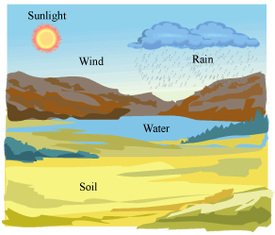
Ecosystem
(noun) All the living and nonliving things in an area and their interactions.

Ecosystem
Abiotic Factor:
(noun) The part of the ecosystem that is not alive and has never been alive.

Abiotic Factor.
Biotic Factor
(noun) The part of an ecosystem that is alive.

Biotic Factor
Adaptation
(noun) A characteristic that help an organism survive in its environment.

Adaptation
Biome
(noun) A plant and animal community that covers a large part of the Earth
Detritivore
(noun) An organism (as an earthwor, or a fungus) that feeds on dead and decomposing organic matter.
 |
| Ecology. |
|
| Ecosystem |
 |
| Abiotic Factor. |
 |
| Biotic Factor |
|
| Adaptation |
Fossil Fuel
Fossil Fuel came from:
Carboniferous Period
- about 360 to 286 million year ago
- or age of dinosaurs
- their was a lot of swamp
so when creature die
- they sink to the bottom of the ocean and swamp over 1 million years.
-They start to decompose from layer of sand and mineral.
The type of fossil fule depend from
- Time
- Tempeture
- Organic Matter
- Pressure Condition
The 3 major fossil fuel
-Coal
-Oil
-Natural Gas
Coal
Come from plants and trees which are harden by pressure and heat.
Oil
Come from small creature which is pressured toguether.
Natural Gas
The proses is the same as oil accept more pressuer and heat.
The type of fossil fule depend from
- Time
- Tempeture
- Organic Matter
- Pressure Condition
The 3 major fossil fuel
-Coal
-Oil
-Natural Gas
Coal
Come from plants and trees which are harden by pressure and heat.
Oil
Come from small creature which is pressured toguether.
Natural Gas
The proses is the same as oil accept more pressuer and heat.
Station Rotation
1# Pond Water: Bacteria
-inc.
2# Ph of Ocean Water
Ph
- scale goes from 1-14
- 7.5 is neutral
- 6 or lower is acidic
- 8 ot higher is alkaline
How does this relate to the environment?
-The oceant is getting more accidict because
- Their more Co2 from cars and factory
- The ocean absorb it to create carboning acid
- It damage a lot of sea life because the rise of acidict level
3# Tap Water And Chlorine
-inc
DNA Note
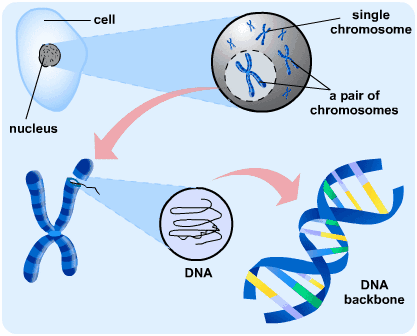
Where is DNA found?
-DNA is a molecule located in the nuclease of the cell
-Nitrogen base are connected by nitrogen bond
-It look like a intertwine ladder
-They can replicate
-They can replicate
What have DNA?
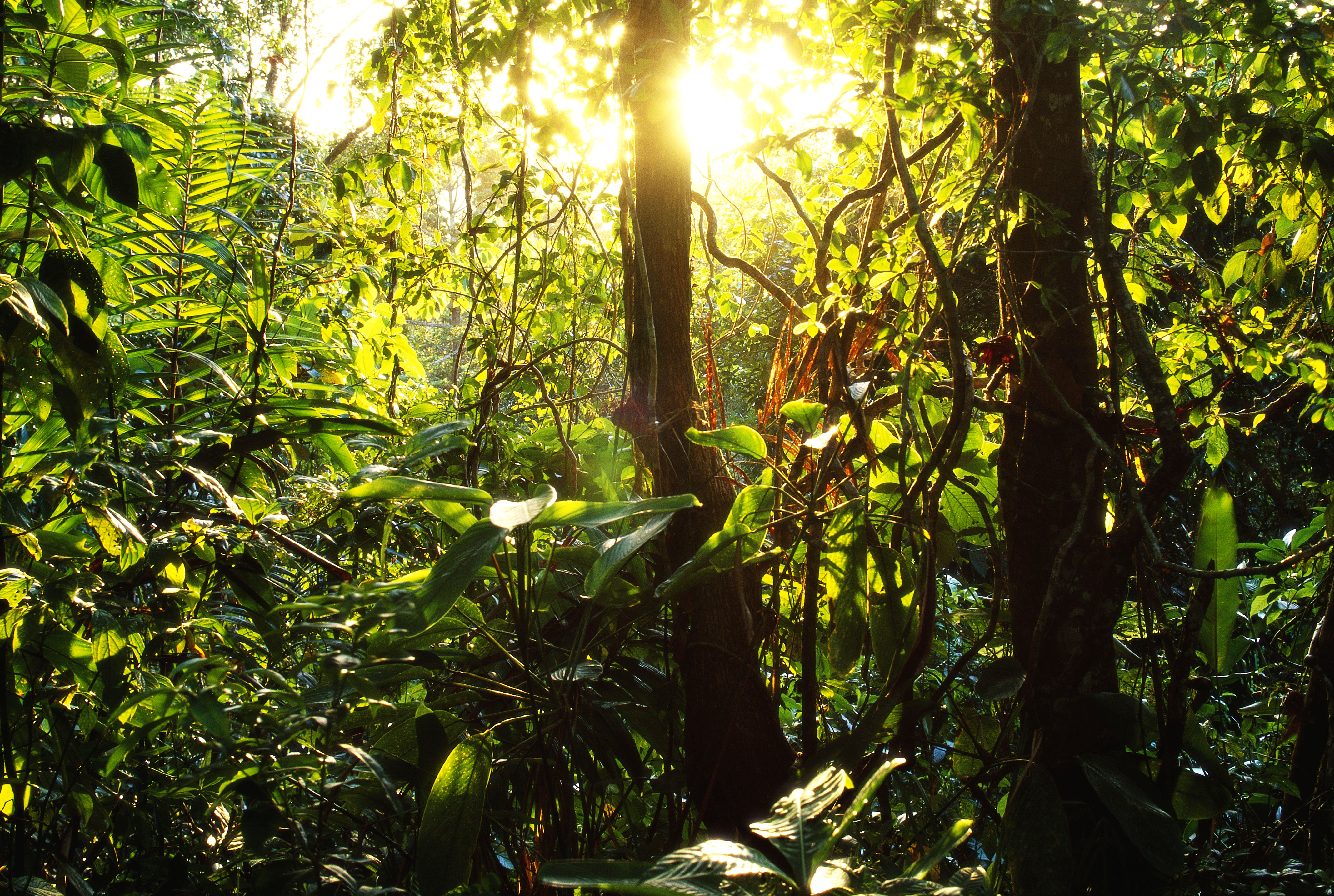
DNA will always be located or came from a living object.
Such as:
-Human
-Animal
-Plants
-And sometime Virus
-Animal
-Plants
-And sometime Virus
There 4 Nitrogen base:
-Adenine
-Cytosine
-Guanine
-Thymine
There a single base that always connect with the double carbon base
-Single base = Pyrimidine
-Double base = Purine
So...
- Pyrimidine = Cytosine and Thymine
- Purine = Adenine and Guanine
That why...
- Adenine and Thymine connect
- Guanine and Cytosine connect
The hydrogen bond and the hydrogen base
- Easily split
- There ment to split
- They usally "unzip" by an ezyme called Helicase
The sugar-phosphate backbone bond
-is so strong, they do not split.
The stand of The DNA is antiparallel which flow in different direction.
There is two 3' prime to 5' prime and a 5' prime to 3' prime
DNA replication is:
- when a DNA unzip into to perfect replicate
- Als when they unzip, they split into two strand
* Top Strand is called leading Strand
* Lower Strand is called lagging strand
- Purine = Adenine and Guanine
That why...
- Adenine and Thymine connect
- Guanine and Cytosine connect
The hydrogen bond and the hydrogen base
- Easily split
- There ment to split
- They usally "unzip" by an ezyme called Helicase
The sugar-phosphate backbone bond
-is so strong, they do not split.
The stand of The DNA is antiparallel which flow in different direction.
There is two 3' prime to 5' prime and a 5' prime to 3' prime
DNA replication is:
- when a DNA unzip into to perfect replicate
- Als when they unzip, they split into two strand
* Top Strand is called leading Strand
* Lower Strand is called lagging strand
Mental Health Awareness
1. So what a mental disorder?
A mental disorder is a diagnosable illness that cause:
- change of person thinking, emotional state and behavior
As well disrupts the person ability to:
- work or attend school
- carry out daily activity
- engage in satifying relationships
2. What the most common metal disorder?
One of the most common mental disorder is:- Anxiety
- Depression
- Anorexia
- Bulimia
- Binge Eating Disorder
Anxiety is when a person:
- Feelings of apprehension or dread
- feeling tense or worse
- trenors or twitches
- Anticipating for the worst
Test Taking Skill for Science
Jan.10, 2017
- Tip #1: What is the question asking?
- Tip #2 Write down Everything you know
- Tip #3 Look a one at a time, T/F/?
- Tip #4 Which answer is answering the question?
- Tip #5 Which one is the Best answer
Brain Narrative
Medulloblastoma is the most common malignant (or infectious) brain tumor that only affects of 20% of children’s brains and is rarely seen in a adult brain development. What Medulloblastoma does is spread to multiple sections of the brain and spinal cord and will kill you if not treated on time. One of the symptoms that will occur if you have Medulloblastoma is headaches, nausea, vomiting, and problems with handwriting. One of the more serious symptoms happen if the tumor was to reach your spinal chord is back pain and trouble walking. However if you go talk to a doctor on time, the a life procedure will save your life. The survival rate of Medulloblastoma is from 70% to 80% if it didn’t spread however if it reach the spinal cord, it drop down to 60%. According to St. Jude Children's Research Hospital, kid of age 3 or younger have the lowest survival rate because the disease is more aggressive. Once you contacted a doctor, they will do a brain surgery to take out as much tumor as possible. If they got rid of all tumor, they will reduce the radiation the patience have. However if the tumor or cancer is spreading, they will increase the radiation kill of or stop the growing process of the tumor or cancer. Once is all done, the final step of recovery is chemotherapy.
Photosynthesis
Nov. 14, 2016
Photosynthesis, the process were it turn sunlight and co2 to oxygen and glucose (or reverse cellular respiration), the necessary need to keep animal alive. But how does it work? Let find out. First off we start with the sunlight hitting the plant. The plant absorb the photon of the sun by a pigment called chlorophyll. Once an electron absorb the energy of the photon, it must transform that energy to something useful so the plant can use it. So that energy is transform by the PSll (Plastoquinone Oxidore) which create chemical reaction so important that the end product called, Oxygen. Then that same proton is move by the cythocrome complex to the PSl. Then PSl use all that energy to create NADPH. Finally that energy is moved to calvin cycle or the dark reaction because they don't require energy of the photon.The end result of this is that now they can create any carbohydrate such as glucose, starch, and cellulose the help out the plant.
Science Lab: Cellular Respiration
Oct. 11, 2016
Fun Fact :
- The energy that is created by glucose is distribute by 70% Basal life process (liver ,brain, hearth, ect.), 20% physical activity and 10% in digestion of food
- The energy we eat from food is turn to ATP however we only get 40% and the rest is burn up
First you start in the cytoplasm which break down glucose(C2,H12,O6) and six oxygen molecule (o2 6) using glycolysis to create ATP. Then the nutrient it transfer in the kreb cycle which output co2, H+, and more ATP. The final stop is the electron transport chain which in simple term is a factory that create Co2, H20 and even more ATP. And that cellular respiration.

No comments:
Post a Comment